• About
  • Books

Footsteps of the Artists

~ Follow the artists in France

Footsteps of the Artists

Category Archives: Artists in Paris

Jean-Pierre Redouté :: Artist at Chateau Malmaison

Monday, July 23, 2012

Posted by L. Peat O'Neil in Artists in Paris, Artists Near Paris, France Travel, Gardens in France, Paris

≈ Leave a comment

Tags

botanical painting, Josephine Bonaparte

Chateau de Malmaison

For Joséphine de Beauharnais Bonaparte, the Chateau de Malmaison —  just outside Paris, with its abundant gardens and enveloping forests — was a cherished retreat, her respite from the demands of Paris and Napoleon’s court life. Today it is a delightful oasis and a museum dedicated to Joséphine and Napoleon.

The Chateau de Malmaison, or “bad house,” as it was called in the Middle Ages when the property was the site of a leper colony, is nestled in a small forest near the Parisian suburb Rueil-Malmaison. When Joséphine bought the house in 1799, it was the centerpiece of a 640-acre estate, which has shrunk to six hectares (14.8 acres). Today, residential apartment buildings sit on land that was once part of the empress’ great park.

The original Malmaison was built in 1622. After the imperial couple completed their renovations, the chateau incorporated elements of the neoclassical Empire style then flourishing. Malmaison is spare and compact, but the use of such details as wide window casements, decorative cornices and molding as well as neutral floor covering and mirrors gives the illusion of spaciousness.

Malmaison had several owners after Joséphine, including Napoleon III, who was Napoleon Bonaparte’s nephew and step-grandchild, the son of Josephine’s daughter Hortense de Beauharnais and Napoleon’s brother Louis. The  philanthropist Daniel Osiris bought the house and grounds in 1896, financed restoration and presented Malmaison to France to be used for a Napoleonic museum. Further acquisitions and careful preservation have enhanced the property.
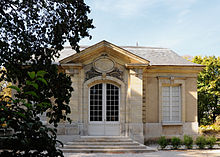
Osiris Pavillion

As one enters the grounds, the surprisingly compact white chateau comes into view, dwarfed by the surrounding woods. In summer the scent of the famous roses planted by the botanist and artist Jean-Pierre Redouté is a pleasant distraction along the gravel paths.


The tour begins with the salons, dining room and music room on the ground floor and proceeds at a leisurely pace. Braided satin cords bar traffic from certain precious carpets, but there is ample time to study the antique furniture and accessories.
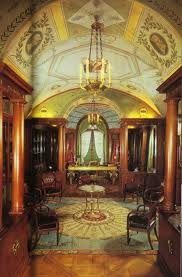
Library at Malmaison.

Napoleon’s war campaign office is re-created in one ground-floor room. Walls and ceiling are covered with striped cloth; crossed spears are set in the corners of this simulated tent. The general’s portable desk dominates the room and, indeed, Napoleon seems almost present as one stands in the midst of the belongings that he took with him to battle.


The music room reveals Josephine’s gentler touch. Delicate paintings of flowers by Redouté decorate the corridor leading to the ornate salon where the empress’ harp is displayed.
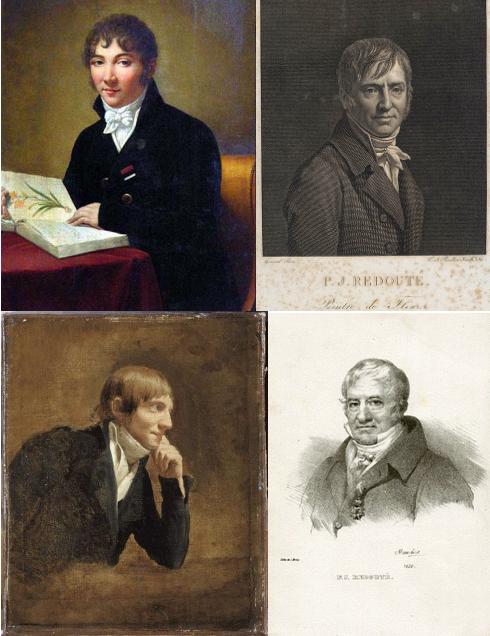
Four faces of P-J Redouté

An elaborate round table covered with signs of the zodiac and mystical symbols reveals another aspect of Josephine. The guide comments that she regularly had her own and Napoleon’s horoscopes cast and that tarot card readings by fortunetellers were routine entertainments in the household.

Lily painted by P-J Redouté

On the second and third floors, the tour continues along some very narrow passageways and into the family bedrooms and a room filled with memorabilia dating from Napoleon’s exile on St. Helena. The tour group buzzed with whispered comments when we came to the Osiris Pavilion on the second floor to view the death mask molded by the Corsican doctor Francesco Antommarchi who attended Napoleon as he died in 1821 on the remote South Atlantic Island, St. Helena. Also on view are the camp bed on which he died and the cover for the catafalque that carried his remains to the tomb.

Josèphine’s bed.

Some of Josephine’s wardrobe spills out of one of the bedroom closets. Cluttering bedside tables and dresser tops are personal souvenirs and toilette items belonging to Joséphine and Hortense, her daughter.

An avid patron of horticulture, Joséphine also left her mark on the gardens of Malmaison, which she employed Redoute’ to lay out. In early summer they are at their most colorful, when rows upon rows of roses are in bloom.
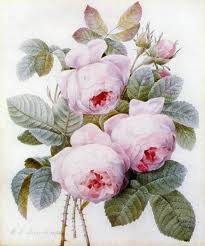
Rose by J-P Redouté

In addition to his horticultural creativity (he developed many new rose varieties for Joséphine), Redouté was one of the world’s greatest botanical illustrators. His meticulous paintings of the roses at Malmaison are among the treasures of the New York Public Library, and his rose varieties grace gardens all over the world.

A few steps from the chateau, in the former stables, is a display of coaches and carriages, including the one Josephine rode in on the return to Malmaison after her humiliating divorce from Napoleon in 1809. Equally poignant is the carriage used by Princess Marie Antoinette of Austria when she came to France to marry Louis XVI.
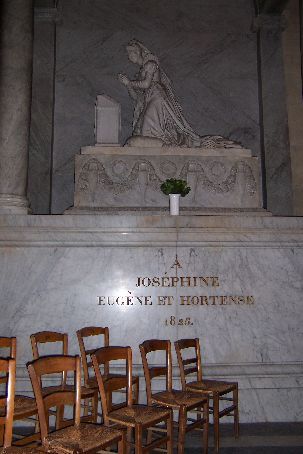
Josèphine’s Tomb

Joséphine lived at Malmaison until her death in 1814. Not far from the gardens she presided over, in the church in the center of Rueil-Malmaison, is her white marble tomb.  With her daughter Hortense, the two women, an empress and a queen, mother and daughter, repose together in the silent church, their vivid lives now history.


Address Book:

Chateau de Malmaison (Avenue du Chateau, Rueil-Malmaison, France). Consult the website for current opening hours, tours and virtual tours.

The museum is open daily, except Tuesdays.  It is closed December 25 and January 1.  The last entry each day is 45 minutes before closing time.  Closing times change depending on the season and are open slightly later on weekends.  Call ahead or check the museum website for specifics.

The chateau is about 12 miles (45 minutes) from Paris by car. Take Rte. N13 west from Neuilly and follow the signs to Rueil-Malmaison and the chateau where there is a free parking lot.

From la Défense metro/RER station: take bus 258 to “Le Chateau” (25 minutes).  Cross the Route Nationale 13 and walk to the chateau about 300 meters.

From Rueil-Malmaison station: take the RER A line  to Rueil-Malmaison, then the “Bus Optile 27” and get off at “Le Château” (8 minutes)

Nearby Attractions of Interest:

On Avenue de l’Imperatrice Josephine, a few minutes’ walk from Malmaison, the Napoleonic pilgrimage continues at Chateau de Bois-Préau, bequeathed to France by Edward Tuck, an American diplomat-banker with a passion for collecting portraits and artifacts of the Napoleonic era. Part of Tuck’s collection is housed in the Petit Palais in Paris.

In nearby St. Germain-en-Laye (also on Rte. N13) is the small Debussy museum, where the composer was born.

A similar version of this article appeared in The Washington Post.

Footsteps of the Artists :: Kandinsky

Sunday, July 1, 2012

Posted by L. Peat O'Neil in Artists in Paris, Artists' Graves, Paris, Study Art in France

≈ Leave a comment

Tags

art history, bohemia, design, painting

Vassily Kandinsky

Born in Moscow in 1866,  Vassilly Kandinsky  (also spelled Wassilly) was raised in comfort and educated to be a lawyer. After practicing law for a few years, Kandinsky started painting at age 30 and pursued art as his passion thereafter.

In Russia up until death of Lenin, artists enjoyed favored status. Creativity was encouraged. Artists produced and their ranks multiplied. Kandinsky’s wild images were strange and wondrous, pushing the use of color to expand consciousness. Much beloved by those who knew him during his lifetime, Kandinsky was a  visionary artist with a global audience for his paintings which are in museum and private collections around the world.

Kandinsky read the occult teachers popular in the early 20th century.  He synthesized evolving precepts of anti-materialism and creativity into his book Concerning the Spiritual in Art published in 1910.

Concerning the Spiritual in Art
by V. Kandinsky

Vassily Kandinsky and his wife Nina moved to Paris in 1933, he came as an exile who’d lost his professorship in Munich after the Nazis closed the school.  They also revoked his German citizenship acquired in 1927.


Vassilly and Nina Kandinsky settled in suburban Neuilly-sur-Seine on the sixth floor of a building overlooking the river.

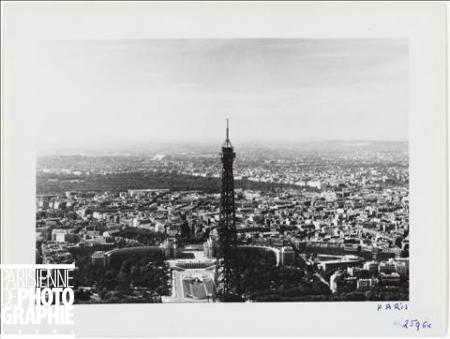
Early 20th c. view of Paris
Neuilly-sur-Seine in distance

This was the era when Paris warmly welcomed refugees from other parts of Europe and beyond. Foreign artists included: Miro,  Mondrian, Max Ernst, Brancusi, Rivera and many others.


They lived near the Bois de Boulogne with a view of Mont Valerien. After Liberation Day in 1945, the Mont Valerien property became a monument to those who were executed for work in the French underground resistance to Nazi occupation.

– Bois de Boulogne, Paris 1925

The Russian-French designer Sonia Delaunay and her husband Charles Delaunay were friendly colleagues of the Kandinskys.  Fernand Leger and Jean Arp were also part of their circle, though Leger spent the World War II years teaching at Yale. Kandinsky liked to vacation at Cauterets in the Hautes-Pyrenees.

Kandinsky Color Study

For Kandinsky, the stateless citizen who fled to Paris, success and appreciation came during his lifetime.  There were exhibitions in 1936, 1939, and 1942 at the Gallery Jeanne Bucher.  Nina Kandinsky dubbed 1934-1944 “the years of synthesis”.

The artist became a French citizen in 1939 and died in 1944.  A school in Neuilly-sur-Seine bears his name.  Kandinsky is buried at New Communal Cemetery, Neuilly-sur-Seine, France.
References

* Hilton Kramer on Kandinsky in Paris, The New Criterion, April 1985.

* Francois Le Targat,  Kandinsky, Rizzoli, 1987.

Flirting in the Literary Cafes of Paris

Friday, June 15, 2012

Posted by L. Peat O'Neil in Artists in Paris, France Travel, Paris, Restaurants in Paris

≈ Leave a comment

Tags

artist cafes, beatniks, bohemia, design, people-watching, philosophy, walk in Paris, writers

The Literary Cafes of Paris Welcome You!

Once upon a nineteenth century, the urban cafe was the place to be. Business, love, the business of love, and affairs of commerce took place in cafes, in full view of the world,  steps from the street.  Many of the cafes are enclosed now with a sound-proof glass between the cafe sitter and the exhaust fumes and passers-by. But inside, with a strong dose of imagination and a sense of history, the Parisian literary cafe mood stews the same scene.

You can sit where the greats once sipped, but to find where tomorrow’s ecrivans are penning, you have to plunge deep into la vie Boheme. Sometimes you’ll find a grimey smoke filled cafe just around the corner from the preserved banquettes that held the shanks of Fitzgerald, Miller, Nin, Flanner, Liebling or Sartre. Sometimes you’ll see a tweedy type with Hemingway’s bulk is still there, as I saw upstairs at Cafe de Flore, editing galley proofs with a fountain pen and sipping whiskey.

Interior of Le Train Bleu Restaurant
at Gare de Lyon.

During the cocktail hour at Le Train Bleu a gloriously guilt-free gilded expanse in the Gare de Lyon (20 Blvd Diderot),  people pose for each other killing time before a train departs, while covertly eyeing who is coming and going. A Japanese man dressed in a cape and suede boots converses intensely with a companion, a trio of German women dieted to fit their thigh-hugging cigarette pants tea and compare the day’s shopping victories. A Marlboro man in leather studies stocks or sports on an iPad.

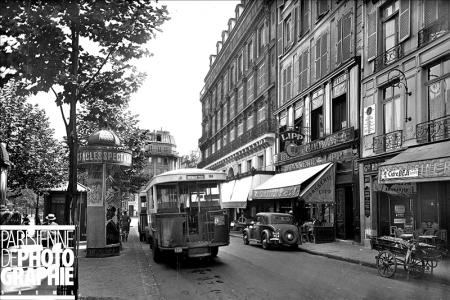
Brasserie Lipp 1930s

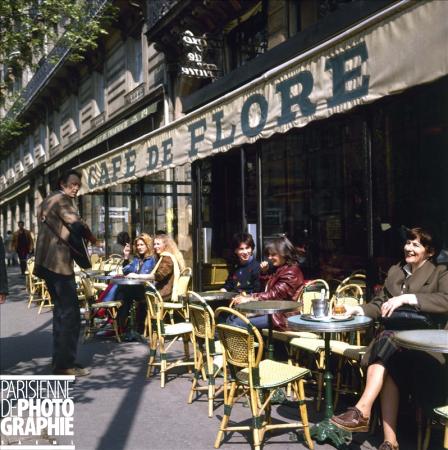
Across town on the Left Bank, the neon and colored tubular glass signs of Brasserie Lipp advertise with jittery color. Just opposite Lipp is the Cafe de Flor, a good place to watch the passing scene sitting behind the broad glass windows.

Upstairs at Cafe Flore, away from the cafe society, a writer in tweeds sits alone and

Cafe de Flore

makes notations on book galleys with a fountain pen. He’s a throwback to the time when political writers crafted manifestos and experimental litterateurs scribbled their thoughts. To the time when Picasso doodled on matchbooks and Sartre confided his quest for a new lover to the understanding ear of Simone de Beauvoir. Cafe Flore’s menu includes sandwiches, snacks, omelettes and salads, some breakfast items, pastries and ice cream, and of course a variety of beverages, from cafe creme to a bottle of Dom Perignon.

Down at Harry’s New York Bar, sank rue Daw-Noo, (5 rue Daunou) it dosen’t take too long a leap of imagination to transform the hunched hacks at the bar into latterday Hemingways, Janet Flanners or Ben Bradlees — journalists and editors serving time in the trenches of Paris.  Pity them not.

Harry’s Bar has been a hangout for Americans in Paris for nearly a century, a place where they could feel at home, stop for a moment and toss back a bourbon or a brew.

I got there around three in the afternoon, after lunch, before the commuter crowd. Inside the curtain that screens the street, a shade of gold suffuses the room, the gold of money and wood aged by many seasons of cigarette smoke and whiskey breath. Harry’s is a bar where men can be men and women can hunt them. A long legged habitue scans the want ads in the Herald Tribune.  She could read it digitally, but where’s the atmosphere and fun in that?

At the opposite end of the limites of the downtown core is picture-perfect Place des Vosges. Said to be the oldest square in Paris, it has been restored and claimed by upscale designers. The wind is cut by the well proportioned houses that line the sides of the square. A secondary line of tended trees muffles noise froum outside the compound. Inside the square the visual range spells sophisticated life, and the calm is all encompassing.

Dozens of famous and extraordinary people have lived here. Madame de Sevigne, a writer and literary figure, was born in one house on the square. The houses on the square perimeter were residences of famous moneyed Parisians of the last century.  Victor Hugo’s house is diagonally across from Ma Bourgogne restaurant where steak and fries are menu staples.  Open every day from 8 in the morning to 1 a.m. the next morning, this is a restaurant that aims to please local sensibilities and visitors from around the planet. By 2 p.m. on a Sunday, French couples are already into their second luncheon course. Writers and students sit outside nursing a pot of tea and reading in the pale winter light reflected in the bleached red brick.

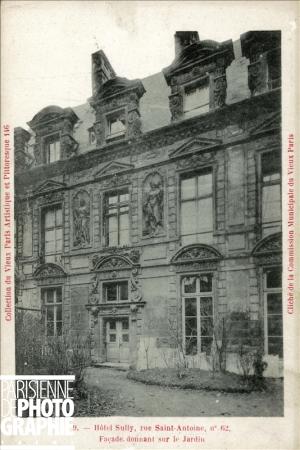
Hotel Sully
1901

Hotel Sully, a grand historic mansion, anchors one corner of Place de Vogues. Vaulted passages around the square shelter galleries, offices and ateliers of famous designers.

Le Procope Restaurant

The oldest surviving and active cafe in Paris is Le Procope (13 rue de l’Ancienne-Comédie).  The tracks of time and re-decoration may have made the restaurant-cafe more polished and slick than when Benjamin Franklin hung out there with his liberty-loving friends.

The cafe is still a place to pause and contemplate the world gone by, to write about it or just stare at the passing scene. People also pass time sitting in cafes to be seen, to feel part of the background life of a city, no longer a tourist or visitor.  The ticket for a seat at the edge of the world’s stage with a front row view costs only the price of a decently pulled espresso.

Address Book:

Le Train Bleu, inside Gare de Lyon, 20 Blvd. Diderot, Metro: Gare de Lyon.

Harry’s New York Bar, 5 rue Daunou, Metro: Opera.

Ma Bourgogne, 19 Place des Vosges, Metro: St. Paul.

Cafe de Flore, 172 Blvd. St. Germain, Metro: St. Germain-des-Pres.

Brasserie Lipp, 151 Blvd. St. Germain, Metro: St.Germain-des-Pres.

Le Procope, 13 rue de l’Ancienne-Comedie,  Metro: Odeon.

Footsteps of the Artists :: Impressionists in Paris

Sunday, May 27, 2012

Posted by L. Peat O'Neil in Artists in Paris, France Travel, Paris, Restaurants in Paris

≈ Leave a comment

Tags

art, art studios in Paris, artist cafes, beatniks, bohemia, philosophy, walk in Paris, writers

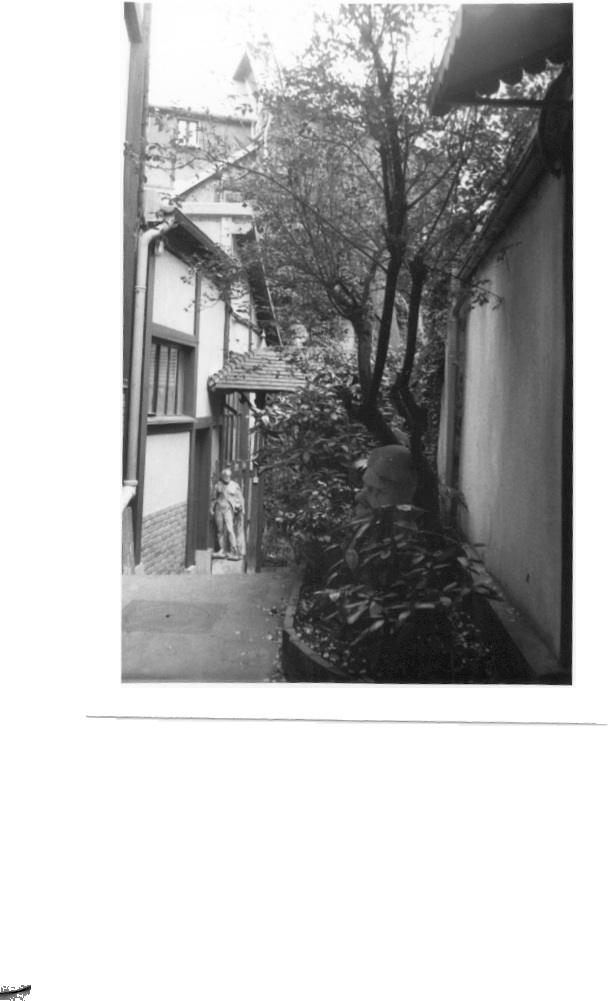
Passageway to hidden artists’ studios in Paris.
© L Peat O’Neil


Footsteps of the Impressionists in Paris


Montmartre

Vincent Van Gogh lived in Paris at 56 rue Lepic, from 1886 to 1888 with his brother Theo.  He painted rooftop scenes from that room and also painted at a friend’s studio, 10 rue Constance.

Sink into the slightly seedy atmosphere of a bohemian artist’s bistro at Au Virage Lepic,  61 rue Lepic. This bar/restaurant is run with an off-hand nonchalance that suggests the boozy haunts of more than a long century ago that attracted Toulouse-Lautrec and other artists to Montmartre. Arrive after late for dinner, or in the morning for a wake-up glass of red.  A group of Parisian mates and I dined there in the mid 1980s. I’m cheered to see the bistro continues to prosper.

Tattered posters cover walls dimmed yellow by clouds of cigarette smoke. Rules about smoking in Montmartre’s restaurants and bars may have changed during the 21st century.  The chef at Au Virage Lepic relies on grilled meat and fried potatoes, timeless staples that no doubt nourished Vincent and Theo Van Gogh and their pals. Late in the evening a chanteuse drops by to pay homage to Edith Piaf.

Luxembourg Gardens

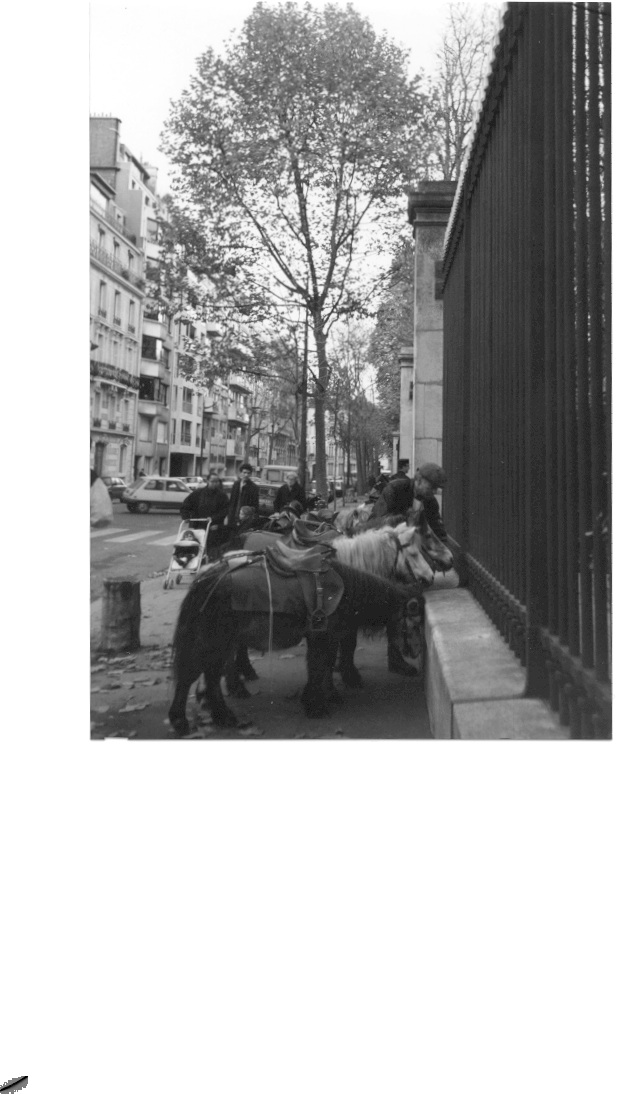
Ponies awaiting riders outside Luxembourg Gardens.
© L Peat O’Neil

While he lived in the Luxembourg quarter, James McNeill Whistler strolled rue Notre Dame des Champs and at sundown, modern pedestrians evoke his vague street scenes with daubs of colorful clothing on a grey dusk background. When he returned to Paris from London in 1892, Whistler painted in a studio on the sixth floor at 86 rue Notre Dame des Champs. The building cornerstone is dated 1880, so it was relatively new when Whistler leased space.  The exterior is painted pale peach with white trim.

Whistler’s aura lives in the building where his British pals — dubbed the “Paris Gang” — had studios in the building at 53 Notre Dame des Champs and Jamie Whistler, the expat American,  was a frequent visitor. Today, the building is called Lucernaire and serves as an arts center, with cinema, theaters, galleries and cafes. Lucernaire was founded by Christian Le Guillochet and Luce Berthomme for actors, writers and cinematographers during the 1960s to reanimate the French cafe-theater movement.

Montparnasse

Art Studios known as La Ruche or Beehive.
© L Peat O’Neil

At 8 rue de la Grands-Chaumiere, off rue Notre Dame des Champs, a brass plate marks Atelier Modigliani, the artist’s last studio. “Modi”, as his colleagues called him, lived and worked there until friends transported him to the charity hospital at 47 rue Jacob where he died a couple of days later from tuberculosis January 24, 1920.

Gauguin also lived and worked in that building and next door, at number 6, a classic artist’s studio with wrought iron art nouveau windows in the style favored at the Glasgow Institute of Fine Arts.

Other remarkable people called this area their own. The literary critic and cultural historian Charles Sainte-Beuve lived at 19 rue Notre Dame des Champs while befriending Victor Hugo’s family who lived at number 11, decades before the Impressionists and their contemporaries arrived in the neighborhood.  Dozens of other artists worked in the area which makes an interesting walk from Metro station Notre-Dame-des-Champs.

Though only 137 meters long, rue Grands Chaumiere was an artists’ street throughout the 19th century and retains its reputation for its fine art schools, student residences, studios and painter’s supply stores. Restaurant Wadja, next to Atelier Modigliani exudes arty atmosphere.

Both Gauguin and Rousseau painted at studios in the Montparnasse neighborhood, but few vestiges of the artistic life endure. A meagerly stocked art supply store that I noted in 1988 at 26 rue Vercingetorix, not far from Paul Gauguin’s studio at number 6, is a decorator’s shop in the shadow of high rise towers like most of the neighborhood. Nearby at number 2 rue Penrel, Henri Rousseau lived for years, but street widening swept away his cottage and the lane is now part of a children’s playground.

Notre Dame du Travail

In the shadows of these pale post-modern office buildings is a unique church, Notre Dame du Travail de Plaisance at 59 rue Vercingetorix. Exposed iron girders like those used by Gustave Eiffel for his tower, replace the masonry buttresses one expects in a gothic style church. Instead of the usual painted images of saints on the chapel walls, the inspirational figures are white washed and decorated with art nouveau borders, like the edges of a page.

Latin Quarter

Artists have long been associated with the left bank and Latin Quarter near the Sorbonne and l’École des Beaux-Arts. Picasso lived and worked at 7 rue Grands-Augustins from 1936 until 1955. He painted his mural “Guernica” there. A plaque on the wall proclaims his tenancy. The house is within a minutes’ walk of rue Christine where Gertrude Stein and Alice B. Toklas lived at number 5 where ivy covers the square pillar at the base of the stairs, obscuring the house number. When my father studied and worked in Paris after the Liberation of France in 1945, he and other Army chaps paid homage at the Stein-Toklas house.

Picasso’s Barcelona heritage is reflected in the Catalan bookstore that anchored rue des Grands Augustins where it intersects rue St. Andre des Arts for decades. As the neighborhood has experienced an influx of upmarket tenants, the bookstore faced closure with a brave face. Picasso is said to have enjoyed the fare at the restaurant Jacques Cogna, 14 Grandes Augustins, which is still in business in the 21st century.  Browse the used bookstores along rue St. Andre des Arts.

Todays posers and painters may drink at Bar Mazet, 61 Rue St. Andre des Arts, which was a rough and tumble cafe and beer-hall in the early 1990s and is now an Irish sports pub.  Or, head around the corner to  23 rue de l’Ancienne Comedie which was once the Relais Odeon, but in its 21st century incarnation is a fancy bakery.

In the heart of the busy, golden Blvd. Saint Germain, Café de Flore was Picasso’s hangout, along with distinguished writers and intellectuals of the late 1920s and 30s. Sartre and de Beauvoir wrote and played footsie there. One can assume that Picasso doodled on menus or matchbooks and Hemingway plotted conquests.  The waiters are consummate professionals; show your sophistication with humility for the grand tradition.

Also on the left bank, the rue de l’École de Medecine still exists, but a textbook store and part of the medical school claim the space that was once Brasserie Andler at 24-30 rue de l’École de Medecine, where during the last two decades of the 19th century, Courbet, Baudelaire, Corot and the older impressionist painters and symbolist writers congregated and traded toasts. Painter Rosa Bonheur lived at number 24 from 1864 to 1866.

Right Bank

Though not part of the Impressionist Movement, Eugene Delicroix developed a painting style that evoked light and movement through innovative brushwork and a complex color palette. The Delicroix Museum at 6 rue de Furstenberg facing a calm residential courtyard, is a gem of a small museum preserved by the Musees Nationaux. The painter’s house and studio are open for view and an array of his works are displayed.

In the posh area near the Champs Elysee, the American painter Mary Cassatt lived on the fifth floor at 10 rue de Marignan, a quiet side street. The fifth floor is at the top level of the building. Twentieth century tenants include a life insurance company and a gynecologist’s office.

In the fashionable 16th arrondissement, painter Berthe Morisot and her husband Eugene Manet, brother of painter Edouard Manet, built the house at 40 rue Paul Valery, known as rue de Villejust before 1945. In her diary, their daughter Julie Manet records the frequent visits of other impressionist artists — Degas, Claude Monet, Renoir and others.

Le Bal Mabile painted by Jean Beraud

The public dance halls and outdoor dancing parks such as Bal Mabille provided artists their choice of comely models.  They picked up dancers to be pose for them, and some became their companions. For 2 francs entrance fee, people could dance the waltz, quadrilles, mazurkas and polkas.  Toulouse-Lautrec was fond of painting the dance hall girls and singers at Thermes Saint Honore, which, alas, was destroyed.

In the Odeon neighborhood, Cafe Voltaire is history. In Montmartre, the country lanes Renoir, Gauguin and Van Gogh strolled are trimmed and paved. Montmarte Cemetery is a peaceful reminder of the past.  But elsewhere artist’s garrets rent for a fortune and gallery owners want to see a deep resume before considering paintings. Paris has changed in at least one aspect as hometown for the world’s artists; it costs more.

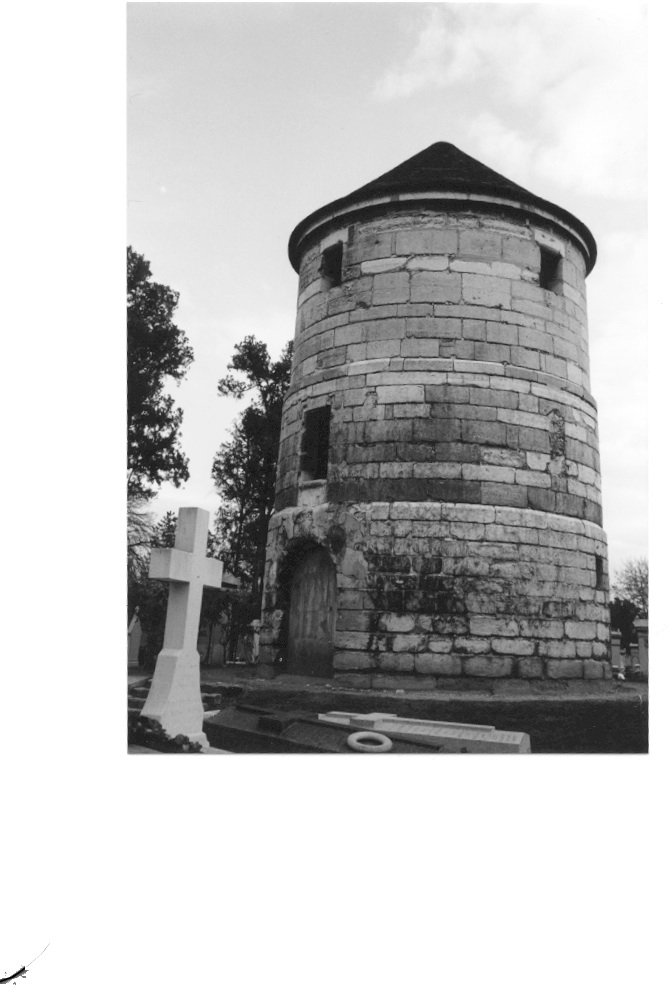
Montparnasse Cemetery with windmill built by Les Frères de la Charité (Brothers of Charity). © L Peat O’Neil

Walking where the famous artists did, seeing their rooms and studios (or whatever has replaced those structures) or visiting their graves, nurtures deeper understanding of their lives and work. Following their footsteps and imagining their daily lives, where they created, drank and talked transposes time and stretches one’s own vision.

Address Book

Artist’s Cafes — Almost any cafe or bar near an art school has “artists-in-residence”. Be aware that not all restaurants, bars or cafes are open on Sunday and in Paris many establishments lock their doors during August.  The places listed below may well offer menus far more expensive than students or emerging artists could afford.

Café de Flore, 172 Blvd. St. Germain. Metro: St. Germain des Près.

La Palette, 43 rue de Seine. Metro: Mabillon.

Le Petit Zinc, 11 rue Saint-Benoit.  Metro: St. Germain des Près

Restaurant Wadja, 10 rue de la Grande-Chaumiere. Metro: Vavin.

Study Art in Paris

Saturday, May 26, 2012

Posted by L. Peat O'Neil in Artists in Paris, France Travel, Paris, Study Art in France

≈ Leave a comment

Tags

art, art history, design, education, painting, photography, sculpture

Step into the Paris that seduced artists from all over the world — the Paris of your dreams.  We’ll show you around Paris of the 21st century with an eye to the traces of decades and centuries past. Like the bumbling hero in Woody Allen’s clever film Midnight in Paris, you can step through the veil of time and paint yourself into a living reverie.  Let us be your guide while you experience the captivating scenes and mysteries of the City of Light.

We’ll follow the Footsteps of the Artists all around France, and visit resort locations where artists and writers gathered to savor nature and revive their enthusiasm.

Research for Footsteps of the Artists covers four decades of living and walking through French cities and towns.  We’ll start with a particular focus on Paris by visiting the academies and studios of artists who created in the city that is sometimes called everyone’s hometown of the heart and soul.

Make your dream of painting in France come true.  Explore these selected art study opportunities and create your trip.  Studying art in Paris is possible!

Art Study in Paris

Wice,  an Anglophone organization in Paris, offers art history tours, painting classes and French lifestyle orientation for visitors and residents.

Montparnasse was once the heart of alternative living in Paris.  Écoles de Condé, a design and graphic arts academy, provides an innovative avant-garde atmosphere that echoes the the eras that attracted international artists to Montparnasse from the 1880s to the current day.

Led by a faculty of internationally acclaimed artists, the Parsons in Paris program provides entree to galleries and art collections. Continuing education courses offer a chance to study fashion design, illustration or art.  Experience the best of the world’s art capital by attending one-week drawing and painting sessions tailored for adult learners at the Parsons Studios, 14, rue Letellier on the left bank near the Eiffel Tower.

The American University in Paris offers summer art courses for degree and non-degree students.

Region:  Gascony – Southwest France

The Nadaï Advanced School in Decorative Painting offers high quality teaching in decorative techniques such as  faux marble, patina, murals and trompe l’oeil. Courses are taught by accomplished masters and renowned artists, notably Michel Nadaï, designated a Meilleur Ouvrier de France (best fine artist) by the French government. The courses are taught at the  atelier in the bucolic Southwest region of France.

The Painting School of Montmiral offers courses for small groups of serious students at all levels, beginner to professional.  Students work in the medium of their choice.  The school leader — artist Francis Pratt — has done research into how we use our eyes when painting and drawing and has published widely.

Region: Provence – Southern France

Lacoste, now part of the Savannah College of Art and Design (SCAD), is a unique artistic community located in the medieval village of Lacoste in the Luberon area of Provence. Lacoste’s faculty are part of SCAD. Teaching assistants and visiting artists are chosen for their ability to share their knowledge, skill and personal attitudes.

The Marchutz School offers courses in Painting, Drawing, and Art Criticism for undergraduates and non-traditional students.  The school’s location in Aix-en-Provence offers incomparable landscapes; this is region where Cezanne lived and painted. Students travel around the region and beyond to take full advantage of the landscape, architecture and museums.

Region: Brittany – Northwest France

The Pont-Aven School of Contemporary Art is an international academy of studio arts and art history in the historic artist colony of Pont-Aven in Brittany, on the Atlantic coast west of Paris. Courses focus on the history and avant-garde traditions of the area as well as the ancient standing stones of Carnac.

Newer posts →

Archives

  • September 2023
  • July 2019
  • May 2017
  • February 2014
  • January 2014
  • July 2013
  • February 2013
  • January 2013
  • December 2012
  • November 2012
  • October 2012
  • September 2012
  • August 2012
  • July 2012
  • June 2012
  • May 2012

Categories

  • American Artists in France
  • Artist's Studios
  • Artists in London
  • Artists in Paris
  • Artists Near Paris
  • Artists' Graves
  • Bookstores
  • Catalonia
  • Cathars
  • Feminist Leaders
  • France Travel
  • Gardens in France
  • Hotels in Paris
  • Languedoc
  • Musicians in Paris
  • Nightclubs and bars in Paris
  • Normandy
  • Paris
  • Provence
  • Restaurants in Paris
  • Shopping in Paris
  • Study Art in France
  • Women in Paris
  • Writers in France
  • Writers in Italy

Meta

  • Create account
  • Log in
  • Entries feed
  • Comments feed
  • WordPress.com

  • L. Peat O'Neil

19th c. 19th century 20th c. Alice B. Toklas Americans in Paris Antoinette Foque art Art Galleries Paris art history artist cafes art studios in Paris beatniks bohemia botanical painting cafe-life Casals Cassatt castles chateau Collioure Céret Dalí Debussy Degas design driving tours Dufy Editions des Femmes education Feminist publishers feminists gardens Gertrude Stein Gris Hemingway heretics history impressionists Josephine Bonaparte Kisling Le Notre luxury Matisse Montparnasse museum music painting people-watching philosophy photography Picasso poets Prades religious war Renoir Sarah Stein sculpture Sitges Toulouse-Lautrec Utrillo Valadon Vincent Van Gogh walk in Paris Women's Bookstores Women in Paris writers Yves Klein

Enter your email address to follow this blog and receive notifications of new posts by email.

Blog at WordPress.com.

Privacy & Cookies: This site uses cookies. By continuing to use this website, you agree to their use.
To find out more, including how to control cookies, see here: Cookie Policy
  • Subscribe Subscribed
    • Footsteps of the Artists
    • Already have a WordPress.com account? Log in now.
    • Footsteps of the Artists
    • Subscribe Subscribed
    • Sign up
    • Log in
    • Report this content
    • View site in Reader
    • Manage subscriptions
    • Collapse this bar
 

Loading Comments...