• About
  • Books

Footsteps of the Artists

~ Follow the artists in France

Footsteps of the Artists

Category Archives: Women in Paris

Interview with Antoinette Foque

Monday, September 11, 2023

Posted by L. Peat O'Neil in Artists in Paris, Bookstores, Feminist Leaders, France Travel, Paris, Shopping in Paris, Women in Paris, Writers in France

≈ Leave a comment

Tags

Antoinette Foque, art, Art Galleries Paris, Editions des Femmes, Feminist publishers, Women's Bookstores

My interview with Antoinette Fouque (psychoanalyst, publisher and feminist activist) occurred thirty four years ago in November, 1989 at her office-residence on the rue du Bac, near Boulevard St. Germain. She was a leading modern feminist who launched women’s activism under the banner MLF  Movement de Liberation des Femmes in France. Madame Fouque also founded the first feminist publishing company in Europe, Éditions des Femmes.

She opened our conversation saying that it was an intensely interesting time in social psychoanalysis. “Tres indispensible,” she said, “for women to push for the rights of all women.”  We discussed the legal decision in France concerning a prohibition on wearing the veil associated with traditional Islamic clothing. “Whether it is racism or sexism, basically it is against women,” she said.

On the day I visited,  she had received word of winning a FNAC prize for publishing the work of Clarice Lispector with Virago. A very prestigious award.

Her publishing house is known by feminist publishers around the world. Shortly after Antoinette Fouque founded  Editions des Femmes in 1972,  other French publishers created product lines focused on women’s and feminist issues.  It was an era when new editorial positions with leadership positions were available to female editors.  By establishing Editions des Femmes, Madame Foque was part of a quiet and steady movement to expand options in publishing for women.  More than fifty later, in 2023, there are feminist and woman-focussed publishers in many countries.

Madame Fouque also started a books on tape collection during the 1980s, which at one time accounted  for one-third of Editions des Femmes business.  The recorded books featured readings done by major French actors.

Antoinette Fouque’s house is a pale grey and white symphony accented with copious displays of fresh flowers.  She wears grey slacks and a draped shirt with a topper in white silk.  Glasses evoke Sylvia Beach, the key 1900’s publisher of radically experimental literature.  A trio of excited lap dogs wreck havoc with the silence that otherwise bathes this house.  Her desk faces windows and flowers set in the wide sill.  Glass top bookcases behind.  Couch and chair in white leather.  The afternoon light goes dim as we speak.  She returns again and again to drive home her raison d’etre, the rights of women must be secured first.

“The first requirement is rights and liberties of women around the world.”

Kali, an Indian feminist press, is heavily influenced by government agenda, she notes. Éditions des Femmes remains independent. For the future, she sees an emphasis on the psychological collection, her personal project.

Earlier that day, I had visited the Librairie des Femmes store in Paris at 35 rue Jacob. The design esthetic was spare and bright, even back in 1989. White walls, indirect lighting, uncluttered bookshelves alternated with racks holding greeting cards and audio books.  One corner of the store was reserved for art exhibitions.

My quest was to interest her in helping me find a publisher for an English translation of the diary of  the 19th c. midwife and radical socialist, Suzanne Voilquin. The book details her years as a travelling midwife in Russia during the 1840s.  It was published in French by Edition des Femmes in 1976. But after talking to Antoinette Fouque, it seemed that this diary-memoir about dead feminists was less than crucial in contrast with the monumental political justice and economic equity gaps confronting women around the globe.

I try to show her that the midwife’s diary is relevant to women’s health and security in remote areas even today.  Voilquin was a trained midwife and worked in North Africa from 1834 to 1836 and in Russia during the 1840s. She reports on cholera, plagues and social conflicts. The plight of women with sick children and no financial support then is just as terrible now.

Mme. Fouque suggested inviting a feminist physician to write the introduction to the English version of Suzanne Voilquin’s memoirs. She mentioned Liza Alther, who lives in Vermont, who is connected to the Boston Women’s Health Collective

My tongue stumbling and balking like an overworked mule during the French conversation that touched complex subjects, there was little more to say.  I thanked her for the nearly an hour interview and felt out of step, wondering if my ideas came across. Wondering if my concerns were too harnessed to the past when there is so much to be done in the present.

Throughout her professional life, Antoinette Fouque was an activist focussed on the present politicized feminist era. I was interested in honoring forgotten feminist pioneers, by writing about the achievements of French socialists and feminists in the 1800s.

The Saint-Simonian socialist movement to which Suzanne Voilquin belonged, was active in France and other industrial areas of Europe from about 1830 to 1865. The Paris members had founded and produced women’s newspapers, created classrooms and schools for working-class girls, taught hygiene and pre-natal care to women in disadvantaged communities, and mobilized groups of members to provide medical aid across North Africa. They trained Egyptian and Berber women to be midwives. The principal male cadre of the organization traveled to the Holy Land to search for a female Messiah and planted themselves in Egypt to start the routing for the Suez Canal. Indeed, the midwife’s diary translation project was a look backwards.  I set it aside.  Antoinette Fouque died February 20, 2014.

Resources:

Espace des Femmes events – https://www.espace-des-femmes.fr/

Suzanne Voilquin’s image and book titles are included in her Wikipedia biography.

Art Students and Collectors in Paris

Tuesday, July 23, 2019

Posted by L. Peat O'Neil in American Artists in France, Artist's Studios, Artists in Paris, Nightclubs and bars in Paris, Normandy, Restaurants in Paris, Study Art in France, Women in Paris

≈ Leave a comment

Tags

19th c., 20th c., Alice B. Toklas, Americans in Paris, art studios in Paris, artist cafes, beatniks, bohemia, cafe-life, Gertrude Stein, Montparnasse, poets, Sarah Stein, Women in Paris, Yves Klein

Art Students in Paris During the Golden Age

During the later decades of the 19th century and into the 20th century, Americans made up the largest group of foreigners studying art in Paris.  They worked with the academic painters and sculptors, learning classical style.  Generally, they did not study with the Impressionists.  During the 1890s, hundreds of Americans exhibited in the annual Salons where they competed favorably gaining medals and sales.Woman's Art Journal cover image

The American Art Association or Club provided lodgings for visiting artists in an old school building at 131 Blvd. du Montparnasse with a garden that was also used for stables. Over the decades, the Art Association bounced around Montparnasse to various locations. The next was 82 rue Notre Dame des Champs. In 1897 it relocated to Number 2 Impasse Conti.  By 1906 the association moved to 74 rue Notre Dame des Champs and in 1909 to the rue Jaseph Bara.  It closed in the early 1930s.  There were other facilities that specialized in housing visiting American art students near the various art academies.

Unclothed woman posing for art class.

Women’s art class with female model. École des Arts Décoratifs, Paris.

The American’s Girls’ Club at 4 rue de Chevreuse in the 6th Arr. opened in 1893. The boarding house provided meals, French lessons and social activities for young American women in Paris to study art.  Académie Vitti, 49 Blvd. du Montparnasse,  admitted women and included naked male models in life studies classes, unusual at the time.  F. W. MacMonnies, Whistler’s earlier studio partner, taught at Académie Vitti.

John Singer Sargent‘s studio was decorated to replicate a grand salon with hardwood floors, elaborate fireplace mantels and masses of expensive textiles.  But it was a rented property at 41 Blvd. Berthier, not his own asset.  The scandal attached to his portrait of the grand lady in black with all the skin exposed discouraged conservative patrons.  Sargent moved to England and continued his career as a society portrait painter.

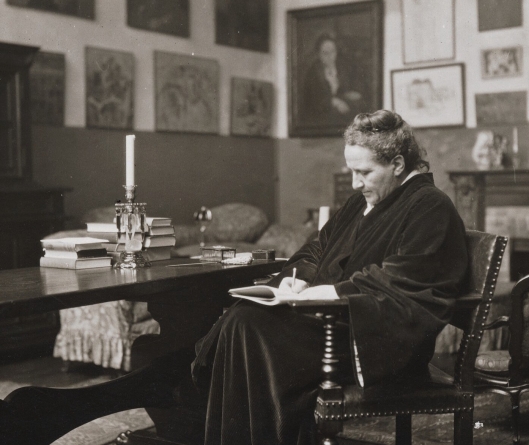
Gertrude Stein in Paris

The Stein siblings — Gertrude and Leo — were living in the house-studio at 27 rue de Fleurus. Alice B. Toklas, Gertrude’s partner, moved in at a later date. Their open house parties attracted artists, writers, patrons and characters, especially Americans. Michael Stein and his wife Sarah Stein lived at 58 rue Madame where their Saturday night gatherings cultivated a salon scene.  All the Steins bought up paintings by Paul Cèzanne, Renoir, Gauguin.  Michael and Sarah were soon onto Matisse, who was supported by them and persuaded by Sarah Stein to open an art school.  Leo was more conservative in building his art collection.  Gertrude Stein focused her collecting efforts on Picasso.

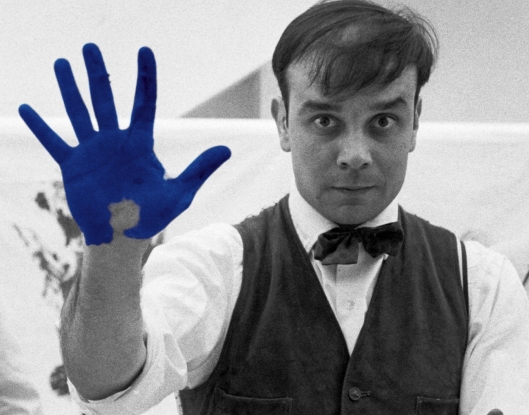
The public garden Square Yves Klein at the southern end of rue Campagne Premiére honors the intense post-WWII modernist who experimented with a particular blue color that bears his name, International Klein Blue.  During the artist’s short, active career, his studio was at 9 rue Campagne Premiére, later becoming number 24.

Yves Klein's hand is International Blue Klein

Yves Klein’s right hand is the color he invented International Blue Klein.

Born in 1928 in Nice, Yves Klein started out in the martial arts, earning the highest honor in judoka and lived in Japan for more than a year. He worked hard and died young of a heart attack on June 6, 1962 aged 34.

 Nearby:

Theatre Lucernaire – 53 rue Notre Dame des Champs, 75006 Paris.  Art house theater, cafe and exhibition space.

Archives

  • September 2023
  • July 2019
  • May 2017
  • February 2014
  • January 2014
  • July 2013
  • February 2013
  • January 2013
  • December 2012
  • November 2012
  • October 2012
  • September 2012
  • August 2012
  • July 2012
  • June 2012
  • May 2012

Categories

  • American Artists in France
  • Artist's Studios
  • Artists in London
  • Artists in Paris
  • Artists Near Paris
  • Artists' Graves
  • Bookstores
  • Catalonia
  • Cathars
  • Feminist Leaders
  • France Travel
  • Gardens in France
  • Hotels in Paris
  • Languedoc
  • Musicians in Paris
  • Nightclubs and bars in Paris
  • Normandy
  • Paris
  • Provence
  • Restaurants in Paris
  • Shopping in Paris
  • Study Art in France
  • Women in Paris
  • Writers in France
  • Writers in Italy

Meta

  • Create account
  • Log in
  • Entries feed
  • Comments feed
  • WordPress.com

  • L. Peat O'Neil

19th c. 19th century 20th c. Alice B. Toklas Americans in Paris Antoinette Foque art Art Galleries Paris art history artist cafes art studios in Paris beatniks bohemia botanical painting cafe-life Casals Cassatt castles chateau Collioure Céret Dalí Debussy Degas design driving tours Dufy Editions des Femmes education Feminist publishers feminists gardens Gertrude Stein Gris Hemingway heretics history impressionists Josephine Bonaparte Kisling Le Notre luxury Matisse Montparnasse museum music painting people-watching philosophy photography Picasso poets Prades religious war Renoir Sarah Stein sculpture Sitges Toulouse-Lautrec Utrillo Valadon Vincent Van Gogh walk in Paris Women's Bookstores Women in Paris writers Yves Klein

Enter your email address to follow this blog and receive notifications of new posts by email.

Blog at WordPress.com.

Privacy & Cookies: This site uses cookies. By continuing to use this website, you agree to their use.
To find out more, including how to control cookies, see here: Cookie Policy
  • Subscribe Subscribed
    • Footsteps of the Artists
    • Already have a WordPress.com account? Log in now.
    • Footsteps of the Artists
    • Subscribe Subscribed
    • Sign up
    • Log in
    • Report this content
    • View site in Reader
    • Manage subscriptions
    • Collapse this bar
 

Loading Comments...